Aligning you the leader and the organization you aspire to build.

Organizational clarity. Leadership formation. Both — because neither holds without the other.

Free Diagnostic →

Not a sales call. Not a pitch. A diagnostic tool that names what is actually holding your organization back — and a free 30-minute consultation to discuss what it found.
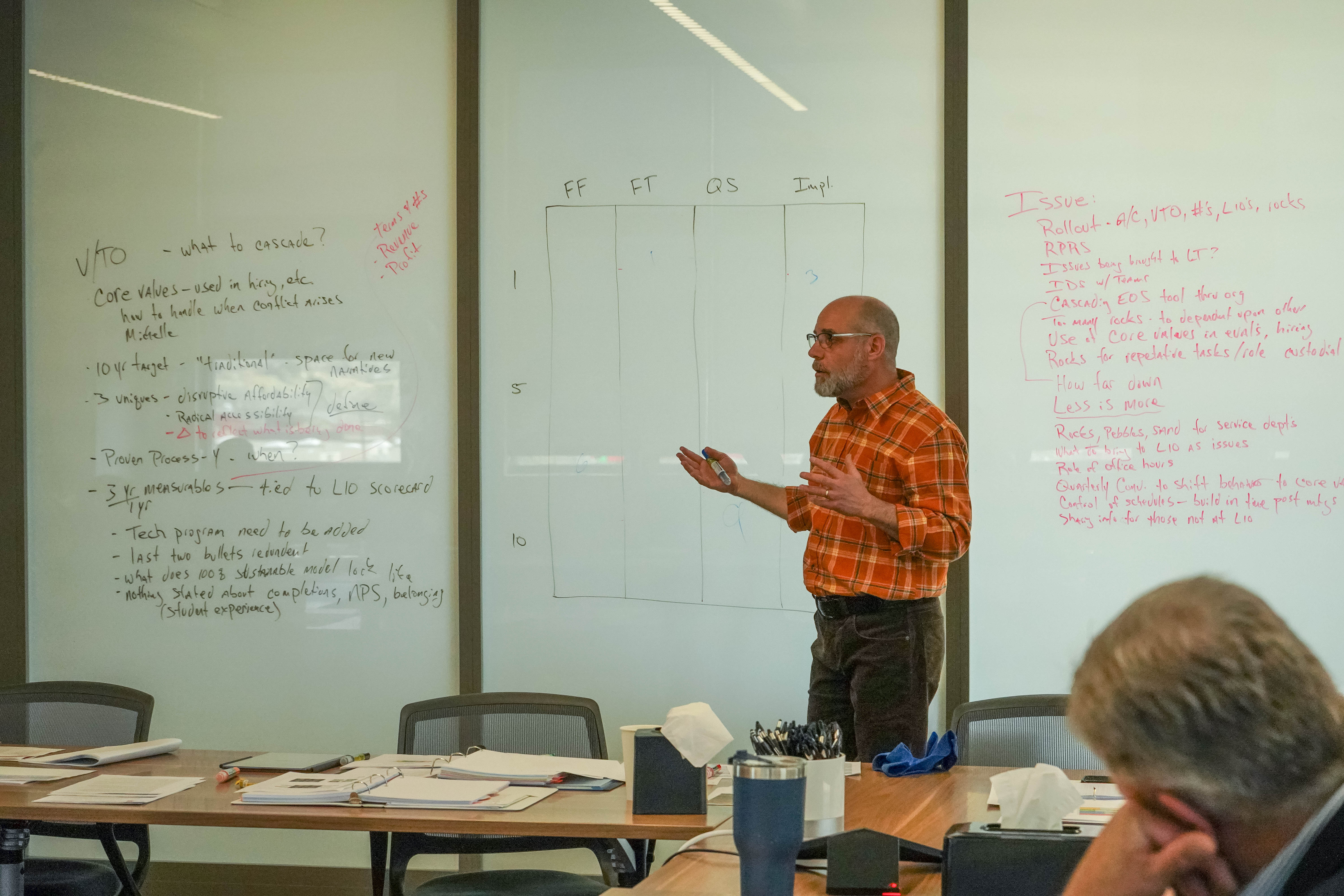
Jay Strear facilitating an EOS session with a nonprofit leadership team

If any of this sounds familiar

You have a strategy. What you don't have is an organization executing against it.

The same problems keep cycling. Your team is talented — but not functioning as one.

Somewhere along the way you stopped leading the organization and started running it. That's a different job. A harder one. And not what you signed up for.

You've tried things. Strategic planning that generated energy and sat in a portal. Coaching that gave you frameworks that didn't transfer. You're not failing. You're operating in a structure that was never designed to support the work you're trying to do.

The gap between the leader you are and the organization you're trying to build — that's where this work begins.

What happens here

Most engagements address the structure or the person. This practice addresses both — at the same time.

Structural work doesn't hold when the leader hasn't done the interior work. And interior work doesn't sustain when the structure keeps producing the same problems.

The framework is EOS — precise, practical, and powerful. It gives your whole team a common language for Vision, Traction, and Healthy.

But EOS is the vehicle, not the destination.

The destination is an organization that matches your values. A team that knows what it owns. A leader who has recovered — or for the first time found — the confidence to lead from who they actually are.

Who this is for

The leaders who get the most from this work tend to arrive in one of three situations. If you recognize yourself in any of them, that recognition is worth a conversation.

Situation 1

You have a vision. It is not becoming an organization.

The strategy exists. The team can articulate it. Quarter after quarter, the same priorities appear on the list without meaningfully advancing. You are not failing. You are operating in a structure that was never designed to support the work you are trying to do.

What the work builds: A full EOS operating system — Vision/Traction Organizer, Accountability Chart, Level 10 Meeting rhythm, quarterly Rocks, weekly Scorecard. Not a better plan. An organization that can finally execute the one it already has.

What changes for the leader: The recurring conversations stop. The team knows what it owns. You reclaim the work that only you can do.

Situation 2

You have made the decision. Now you need to build what comes next.

Something shifted — a partnership that ended, a chapter that closed, a conviction about the kind of leader you will no longer be. The decision was right. What comes next is unclear.

What the work builds: A values clarification process that anchors every structural decision that follows. New operating agreements. An Accountability Chart that reflects the organization you are building, not the one you are leaving behind.

What changes for the leader: The rebuild feels coherent rather than chaotic. Every structural decision connects back to a values foundation. The organization starts to match the leader you have decided to be.

Situation 3

The team that built this cannot take it further. Not together.

Performance has plateaued. A few team members carry a disproportionate load while others underdeliver. The culture has drifted. What got you here is not what will take you there.

What the work builds: An honest assessment of the team using the EOS People Analyzer — the right people (values fit) in the right seats (role fit). A path forward that is direct, humane, and grounded in clarity about what the organization requires. This work often involves hard people decisions. It is done with the conviction that clarity is an act of care — for the people staying and for the people who need to find a better fit.

What changes for the leader: The weight of carrying the team lifts — because the team is finally built to carry itself. Culture reflects values rather than tolerating their absence.

What clients say

“He didn't just walk with me or with the team throughout the process; he helped connect it to our overall purpose.”

“It gave us a system, but it's also given us confidence and alignment — and taught us how to be collaborative partners together.”

“I would tell you, most of all because of Jay, we still exist as an organization today.”

Who gets the most from this work

The leaders who do the best work here wake up asking how they're going to be better — not just more efficient, but genuinely better as a leader and as a person.

They're not looking for a system delivered and departed. They're looking for a partner who will hold them to the hardest version of what that pursuit requires.

If that's the orientation you bring, this works.

Free Diagnostic →

The first conversation is about fit — for both of us.

The first conversation is about fit — for both of us.

jay@streargroup.com · streargroup.com · Denver, Colorado